
India responded to US President Donald Trump's criticism, emphasizing the strength and resilience of the India-US strategic partnership.

US Ambassador-designate Sergio Gor emphasizes the importance of the India-US relationship after meeting with Prime Minister Narendra Modi, focusing on cooperation in defence, trade, and critical minerals.
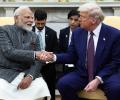
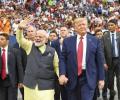
Prime Minister Narendra Modi met United States President Donald Trump at the White House in Washington, DC on Thursday.

Lavrov, who addressed the UN General Assembly shortly before External Affairs Minister S Jaishankar's speech at the high-level General Debate, said India and Russia share a "particularly privileged strategic partnership".
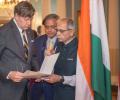
A statement issued by State Department Spokesperson Tammy Bruce said Landau "reaffirmed the United States' strong support of India in the fight against terrorism and the strategic partnership between the two countries".

India and Canada are negotiating a long-term uranium supply agreement worth $2.8 billion. They are also exploring expanded civil nuclear cooperation after the passage of the SHANTI Bill.
United States Secretary of State John Kerry and Union HRD Minister Dr M M Pallam Raju on Tuesday called for greater cooperation between the two countries in the education and knowledge building sector.
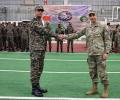
'When our soldiers trained side by side, we demonstrated to the world that our partnership is strong, enduring and prepared to meet any challenge.'
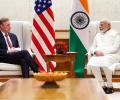
Prime Minister Narendra Modi on Monday met US National Security Advisor Jake Sullivan in New Delhi.
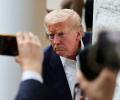
'We are a responsible nation, and would prefer to deal with sensitive issues with the maturity they deserve rather than take to social media.'

India on Thursday said it expects the United States to consider visa applications of Indian students on merit amid growing concerns over the Trump administration halting new student visa interviews.
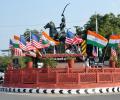
Indo-Pacific region. Senior officials from the ministries of External Affairs and Defence, and the US departments of Defence and State met here for the India-US 2+2 Inter-Sessional meeting.

Prime Minister Narendra Modi on Wednesday congratulated 'friend' Donald Trump on his 'historic' presidential polls victory, and said he looks forward to renewing their collaboration to further strengthen the India-United States Comprehensive Global and Strategic Partnership.
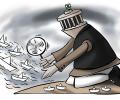
Secretary of Commerce Howard Lutnick has said one should expect a trade deal between India and the US in the "not-too-distant future" as the two countries have found a place that works for them. "So the idea is when they put the right person and India put the right person on the other side of the table, and we've managed, I think, to be in a very, very good place," Lutnick said in his keynote address at the eighth edition of the US-India Strategic Partnership Forum (USISPF) Leadership Summit in Washington on Monday.
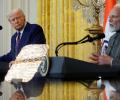
India and the US have entered a new phase in their relationship, marked by greater parity, point out Harsh V Pant and Vivek Mishra.

Extending a formal invitation to Prime Minister Narendra Modi for a visit to the US, President Barack Obama has expressed keenness to work closely with him to make the bilateral relations a "defining partnership" in the 21st century.

Prime Minister Narendra Modi is set to hold bilateral meetings with US President Donald Trump and other prominent American personalities during his two-day visit to the United States.

The Congress party has criticized Prime Minister Narendra Modi's description of India and the US as 'natural partners,' citing President Trump's claims of using trade as leverage in India-Pakistan relations. The remarks come amid ongoing trade negotiations and fluctuating relations between the two countries.

The Centre is regularly holding consultations with stakeholders to streamline foreign direct investments (FDIs) and foreign institutional investments (FIIs) related processes to enable faster and more efficient investment flows into the country, said Commerce and Industry Minister Piyush Goyal, adding one such meeting with stakeholders was held on Tuesday.

The enduring relationship between the two countries have survived the disintegration of the erstwhile USSR in 1991, the end of the Cold War and the regime change in both countries, points out Rup Narayan Das.
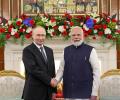
Luckily for us, a Russia that is desperate to stay relevant in an emerging multipolar world finds in India a reliable geostrategic partner. The Russian proximity to India also keeps China from exploiting its economic dominance vis a vis Russia, points out Colonel Anil A Athale (retd).
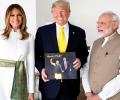
India is working with the US on an "early" visit to Washington by Prime Minister Narendra Modi to further deepen the comprehensive global strategic partnership between the two countries, the External Affairs Ministry said on Friday. Following a phone conversation with Modi this week, US President Donald Trump said the Indian prime minister "is going to be coming to the White House, over next month, probably February". It would be Modi's first bilateral visit to Washington after Trump became US president for a second term. While confirming discussions between India and the US on the proposed visit, External Affairs Ministry spokesperson Randhir Jaiswal did not mention any possible time-line for the trip. In their phone conversation on January 27, Modi and Trump vowed to work towards a "trusted" partnership with a focus on boosting India-US cooperation in areas of trade, energy and defence. "PM Modi and President Trump had a telephone conversation recently. The two sides are working on an early visit of the PM to the US to further deepen India-US Comprehensive Global Strategic Partnership," Jaiswal said at his weekly media briefing while replying to a question. "Specific dates for the visit would be announced at the appropriate time," he said. It is learnt that both sides were initially looking at the window between February 12-14 for Modi's visit but there has been no finality on it yet. The prime minister is set to travel to Paris to attend the Artificial Intelligence Action summit on February 10 and 11. Though the US president has also been invited to the summit, his participation is not yet confirmed.
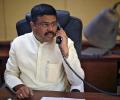
India and the United States have agreed to revamp their strategic energy partnership with a greater focus on cleaner energy sectors, an official statement said. Oil Minister Dharmendra Pradhan on Monday held an "introductory meeting" with US Secretary of Energy Jennifer Granholm. The two leaders reviewed the India-US Strategic Energy Cooperation (SEP). The two nations will intensify efforts to take advantage of advanced US technologies and India's rapidly growing energy market, the statement said.

'This is the first time the US has formally recognised the threat India faces from terrorist organisations based in Pakistan.'
Prime Minister Narendra Modi on Saturday 'deeply' appreciated United States President Donald Trump's 'positive assessment' of the India-US partnership after the American leader hailed the 'special' relationship between the two nations -- remarks seen as an attempt to check the downturn in the ties.

'The bigger unknown remains global geopolitics, which is inherently unpredictable, including developments in our neighbourhood.' 'Another concern is the increasing tilt of government finances towards welfare subsidies, especially at the state level.' 'This could constrain capital expenditure, which is critical for long-term growth.'
No single individual, institution, or action is to blame for this. The BJP is responding in kind -- definitely not without checking with its government. And they wait for Mr Trump, notes Shekhar Gupta.

'Good to meet US Secretary of State @SecBlinken today. I welcome President Biden's strong commitment to strengthen the India-US Strategic Partnership, which is anchored in our shared democratic values and is a force for global good,' Modi tweeted.
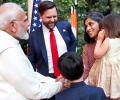
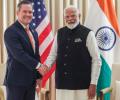
Prime Minister Narendra Modi and US Vice President JD Vance have expressed satisfaction with the progress made in negotiations for a bilateral trade agreement. The two leaders met in New Delhi and discussed a range of bilateral issues, including cooperation in energy, defense, strategic technologies, and other areas. They also exchanged views on regional and global issues of mutual interest.

If Lockheed Martin gets the opportunity, then it will set up a mega hub in India to produce the "iconic" aircraft and it will be the first such global facility outside of the US, top officials of the company told PTI.
Prime Minister Narendra Modi said he had a 'fruitful meeting' with United States National Security Advisor Michael Waltz and they discussed defence, technology and security areas, which are important aspects of the India-US ties.

In the phone conversation on Tuesday, Singh urged Hegseth to expedite the delivery of GE F404 engines to power the Tejas Light Combat Aircraft, people familiar with the matter said.

While both sides have announced the decision to restart talks for a trade deal, government officials said discussions are continuing virtually.
'He needs to see results while he is in office.'
What appeared to be a generous act of friendship was, in truth, a manoeuvre within a much larger strategic game. The United States used the 1962 war not just to aid India but to test how far it could be pulled into the Western fold, points out Dr Kumar.

The India-United States relationship is set to expand under the Donald Trump administration, but there could be some unease on issues like imports, tariffs and immigration, strategic affairs experts said after the Republican leader won the fiercely contested presidential election.
"For instance, you generally buy your military gear from Russia. That's a way to kind of get under the skin of America, if you go to buy your armaments from Russia."

The full text of the Indo-US joint statement released in New Delhi.

India has called for a ceasefire, release of all hostages, and peaceful resolution of the Israel-Hamas conflict through dialogue and diplomacy. The Centre informed Parliament that India welcomed the agreement on the first phase of the Gaza Peace Plan. The article also covers India's energy sourcing strategy and the release of Indian fishermen by Pakistan.

'The border deal offers a hedge for India against Trump's unpredictability when it comes to his approach to competition with China.'
